콜센터 AI is reshaping customer service from a reactive cost center into a proactive, value-driving experience. By combining automation, natural language understanding, and real-time insights, modern contact centers can serve more customers, in more channels, with higher quality and lower costs than ever before. According to the Metapress overview of AI call center improvements, these AI-driven solutions are critical for delivering seamless omnichannel customer journeys.
This guide walks through what Call Center AI is, how it works, and how you can adopt it to deliver faster, smarter, and more human customer experiences at scale.
Implementing Call Center AI requires not only technology but also a clear understanding of digital infrastructure. Many organizations rely on fast computing systems to make sure automated processes run smoothly. With these systems, agents can focus on complex customer questions while AI handles routine tasks.
For businesses looking to grow, powerful supercomputers help analyze large amounts of data quickly. This allows contact centers to track trends in customer behavior and improve response times.
Marketing teams also benefit from AI insights. Using simple AI marketing tools alongside call center solutions helps companies better understand customer needs and deliver personalized service.
Companies are also exploring how AI can guide customer journeys to keep service consistent and efficient. When AI spots common problems early, human agents can step in to help and improve satisfaction.
Financial institutions see strong benefits from AI support. Using financial AI tools helps call centers predict client needs, reduce mistakes, and make operations smoother. Combining AI with human expertise creates better experiences at lower cost.
By bringing together these technologies, Call Center AI transforms customer service into a smarter, more proactive part of any business, supporting both efficiency and growth.
Top 10 Call Center AI Solutions for Modern Customer Support
The demand for intelligent, automated customer service is growing rapidly, and businesses are turning to Call Center AI solutions to improve efficiency, reduce costs, and enhance customer satisfaction. Here’s a list of the top 10 platforms that are leading the way in AI-driven contact center solutions.
1. Bright Pattern: Advanced AI Contact Center Solutions
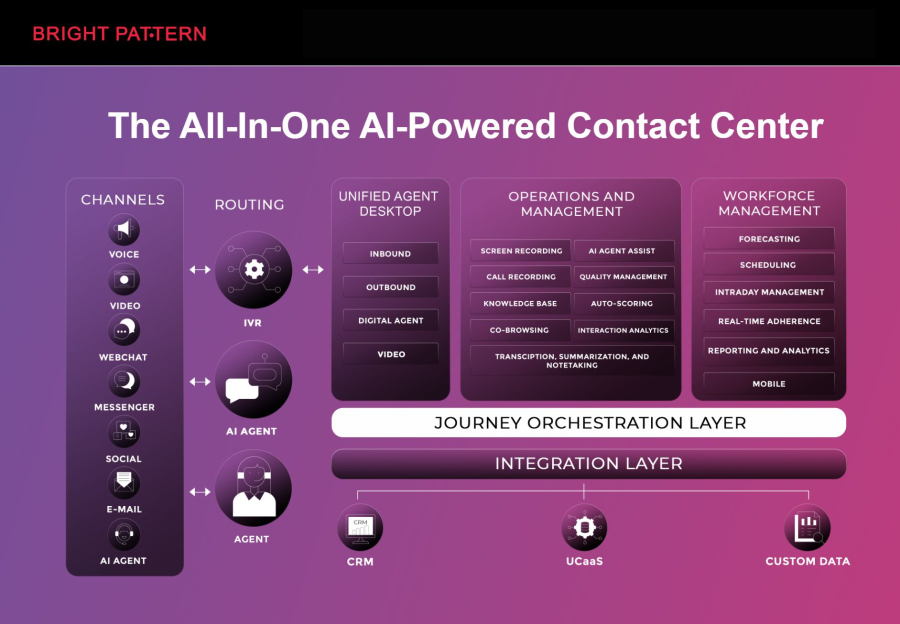
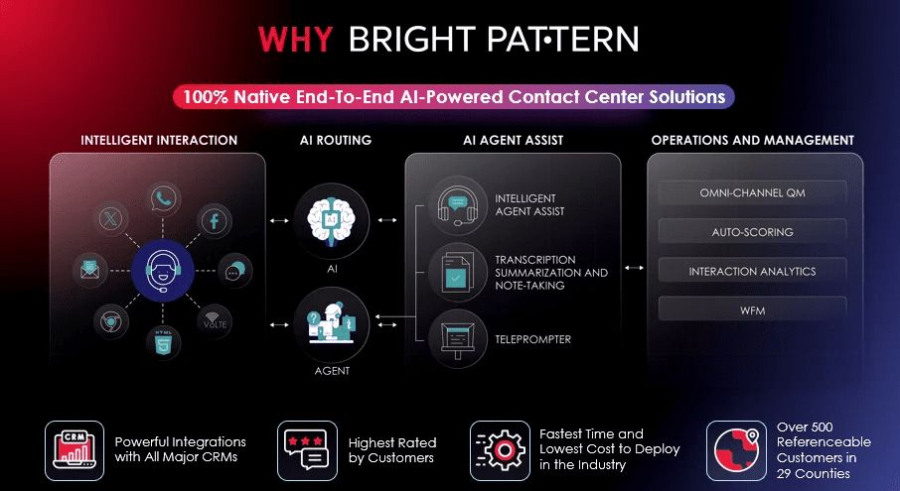
Bright Pattern is a top-tier solution for organizations seeking scalable and intelligent Call Center AI platforms. Its cloud-based contact center software combines automation, omnichannel routing, and AI-driven analytics to deliver a seamless customer experience.
Key features of Bright Pattern:
- AI-powered virtual agents for 24/7 customer support
- Omnichannel contact handling (chat, email, voice, social)
- Real-time analytics and agent performance tracking
- Easy integration with CRM and third-party business tools
- Personalized customer interactions using AI insights
Bright Pattern helps businesses reduce wait times, improve first-contact resolution, and provide more proactive service across all channels, making it a leading choice for modern customer support.
2. 8x8 Contact Center AI
8x8 offers AI-powered contact center solutions with advanced analytics, automated workflows, and omnichannel support. It’s ideal for small to mid-sized businesses looking to enhance customer engagement.
3. RingCentral AI Contact Center
RingCentral provides AI-driven routing, sentiment analysis, and workforce optimization features. Its platform helps enterprises deliver more efficient, personalized support while integrating with popular business applications.
4. Talkdesk AI Solutions
Talkdesk combines AI and automation to improve agent productivity and customer satisfaction. Features include AI-powered virtual agents, predictive routing, and real-time insights into customer interactions.
5. Genesys AI Contact Center
Genesys focuses on customer experience by offering predictive engagement, conversational AI, and omnichannel routing. Its AI tools help agents resolve issues faster and anticipate customer needs.
6. NICE inContact CXone
NICE inContact leverages AI for automated workflows, speech analytics, and customer journey insights. It provides cloud-based solutions to optimize agent performance and improve service quality.
7. Vonage AI Contact Center
Vonage delivers AI-assisted call handling, chatbots, and analytics to streamline operations. Its AI features help organizations reduce costs while maintaining personalized customer interactions.
8. Amazon Connect AI
Amazon Connect uses machine learning to automate routine interactions, provide real-time recommendations, and optimize routing. Its integration with AWS services enables flexible, scalable AI-driven support.
9. Five9 Intelligent Cloud Contact Center
Five9 offers AI-powered virtual agents, predictive dialers, and speech recognition to improve efficiency and customer satisfaction. Its platform is suited for enterprises seeking automation and analytics in one solution.
10. Freshworks Contact Center AI
Freshworks provides AI-assisted support for both agents and customers, offering chatbots, sentiment analysis, and automated workflows. Its solutions are designed to reduce agent workload and enhance customer experience.
What Is Call Center AI?
Call Center AIis a set of technologies that use artificial intelligence to automate, optimize, and assist customer interactions across voice and digital channels. It enhances, rather than replaces, human agents by taking over repetitive tasks and surfacing real-time intelligence.
In practice, Call Center AI typically includes some combination of:
- Virtual agents and chatbotsthat handle routine questions and tasks through voice or text.
- AI-powered IVRthat understands natural speech instead of relying on rigid menu trees.
- Agent assist toolsthat suggest responses, surface knowledge articles, and summarize calls in real time.
- Analytics and quality monitoringthat automatically score interactions and detect trends.
- Workforce optimizationthat forecasts demand and recommends staffing levels.
The result is a smarter contact center where customers get quicker resolutions, agents focus on higher-value work, and leaders gain clear visibility into performance.
Why Call Center AI Matters Now
Customer expectations have changed dramatically. People want fast, personalized, 24 / 7 support across phone, chat, messaging, and email. At the same time, contact centers face rising volumes, high agent turnover, and pressure to control costs.
Call Center AI directly addresses these challenges by:
- Handling a large share of routine interactions automatically.
- Equipping agents with better tools so they can resolve issues faster.
- Providing leaders with data to continuously improve service quality.
Organizations that adopt Call Center AI effectively often see measurable gains in both customer satisfaction and operational efficiency.
Core Capabilities of Call Center AI
While every implementation is unique, most Call Center AI programs are built on several core capabilities.
1. AI Virtual Agents and Chatbots
Virtual agentsuse natural language understanding to converse with customers over voice or text. They can recognize intent, ask clarifying questions, and complete tasks end to end.
Typical use cases include:
- Account balance checks and simple account updates.
- Order status, delivery tracking, and basic returns.
- Password resets and simple authentication flows.
- Appointment scheduling and rescheduling.
Well designed, AI powered virtual agents can resolve a significant percentage of contacts without human involvement, while seamlessly handing off complex cases to live agents when needed.
2. AI-Enhanced IVR and Call Routing
Traditional IVR relies on menu trees ("Press 1 for billing, 2 for support").AI enhanced IVRinstead asks open questions, understands natural speech, and routes callers to the best resource based on their intent and profile.
Benefits include:
- Shorter time to reach the right agent or virtual flow.
- Fewer transfers and call backs.
- Ability to prioritize high value or high risk contacts.
3. Real-Time Agent Assist
Agent assisttools listen to or read live conversations (within appropriate privacy and consent rules) and provide timely support to human agents.
Common capabilities include:
- Real time suggested replies and talking points.
- Automatic retrieval of relevant knowledge base articles.
- Real time sentiment analysis to flag escalations.
- Automated call summaries and disposition codes after the interaction.
This reduces handle time, improves consistency, and lets new agents ramp up faster.
4. AI-Powered Analytics and Quality Monitoring
AI analyticsaggregate and analyze data from every interaction, including call recordings and transcripts. Instead of sampling a small percentage of calls, AI can review them all.
Value generating use cases include:
- Automated quality scoring and coaching suggestions.
- Trend detection for recurring issues or product defects.
- Identification of upsell and cross sell opportunities.
- Customer sentiment and effort scoring across channels.
5. Workforce Forecasting and Scheduling
AI driven workforce managementapplies machine learning to historical volume, seasonality, and campaign data to forecast demand and recommend staffing plans.
This supports:
- More accurate schedules that match demand patterns.
- Reduced overtime and idle time.
- Better service levels during peaks and campaigns.
Key Benefits of Call Center AI
When deployed thoughtfully, Call Center AI can deliver measurable benefits for customers, agents, and the business.
Customer Experience Benefits
- Faster answersthanks to automation and better routing.
- 24 / 7 availabilitywithout needing overnight human staffing.
- Personalized interactionsusing context from previous contacts and customer data.
- Channel choiceacross voice, chat, and messaging, with a consistent experience.
Agent and Team Benefits
- Less repetitive workas simple tasks are automated.
- Smarter support toolsthat reduce searching and after call paperwork.
- Improved coachingthrough objective quality insights and recommendations.
- Higher job satisfactionfrom focusing on complex, meaningful interactions.
Business and Operational Benefits
- Lower cost per contactthrough automation and efficiency gains.
- Higher first contact resolutionby matching customers with the right resource.
- Better compliance and consistencyvia automated monitoring.
- Richer insightsthat inform product, marketing, and service strategy.
Practical Use Cases Across Industries
Call Center AI can be tailored to many industries. Here are some practical, high impact examples.
Financial Services
- Balance checks, transaction history, and card activation via virtual agents.
- Fraud alerts that prioritize high risk calls and route them to specialist teams.
- Agent assistance with regulatory scripts and disclosure reminders.
Retail and E‑Commerce
- Order status, delivery tracking, and store information handled by bots.
- Automated returns initiation and basic refund processing.
- Personalized recommendations and cross sell prompts in digital channels.
Telecommunications
- Self service troubleshooting flows for connectivity and device issues.
- Plan changes and add ons recommended based on usage patterns.
- Proactive outreach when network incidents affect specific customers.
Healthcare
- Appointment scheduling, reminders, and basic triage questions.
- Insurance eligibility and coverage checks.
- Post visit follow ups and satisfaction surveys.
How to Implement Call Center AI Successfully
Winning with Call Center AI is less about buying a specific tool and more about following a thoughtful, step by step approach.
Step 1: Define Clear Objectives and Metrics
Start by aligning stakeholders on what success looks like. Some common objectives include:
- Reducing average handle time.
- Increasing self service containment.
- Improving customer satisfaction scores.
- Enhancing agent productivity and retention.
Translate these objectives into specific, measurable targets and baseline your current performance.
Step 2: Map Journeys and Identify High-Impact Use Cases
Next, map your key customer journeys across channels. Look for:
- High volume, low complexity interactions that are ideal for automation.
- Complex interactions where agents struggle to access information quickly.
- Moments that strongly influence satisfaction or churn.
Select a small number of high impact use cases to pilot, rather than trying to automate everything at once.
Step 3: Prepare Data and Knowledge
AI performs best when it can access accurate, well structured information. Before or while you select technology, invest in:
- Cleaning and organizing your knowledge base.
- Standardizing macros, templates, and processes.
- Ensuring integration points with CRM, ticketing, and core systems are understood.
Step 4: Select the Right Technology Stack
When evaluating technology options, consider:
- Support for your current and future channels (voice, chat, messaging, email).
- Ease of integration with existing systems.
- Capabilities for virtual agents, agent assist, analytics, and workforce management.
- Controls for security, privacy, and data governance.
Look for solutions that can grow with your roadmap rather than solving only one narrow problem.
Step 5: Design Conversational Experiences
For virtual agents and AI IVR, strong conversation design is crucial. Focus on:
- Clear intents and flows based on real interaction data.
- Natural, concise prompts that reflect your brand tone.
- Graceful fallback and escalation to human agents when needed.
- Testing with real users and iterating regularly.
Step 6: Involve and Empower Agents
Agents are critical partners in AI success. Engage them early by:
- Explaining how AI will reduce repetitive tasks and support their work.
- Inviting feedback on pain points and improvement ideas.
- Offering training on new tools and workflows.
When agents see AI as a helpful assistant rather than a threat, adoption and outcomes improve significantly.
Step 7: Launch, Measure, and Continuously Improve
Start with controlled pilots, measure performance against your baseline, and refine. Use AI analytics to identify further opportunities for automation, better routing, and improved knowledge content.
Measuring Success: Key Call Center AI KPIs
Tracking the right metrics helps you demonstrate the value of Call Center AI and guide ongoing optimization.
KPI | What It Measures | AI Impact |
Self Service Containment Rate | Percentage of interactions resolved by automation without agent involvement. | Shows how effectively virtual agents and IVR handle routine tasks. |
Average Handle Time (AHT) | Average time agents spend per interaction. | Agent assist and better routing can reduce handle time. |
First Contact Resolution (FCR) | Percentage of issues resolved in a single contact. | Smarter routing and better knowledge access increase FCR. |
Customer Satisfaction (CSAT) | Customer ratings of their support experience. | Faster, more accurate, and personalized interactions tend to boost CSAT. |
Agent Occupancy and Utilization | How fully agents' time is used productively. | Automation can align workloads with capacity more effectively. |
Quality Scores | Evaluation of interaction quality and adherence to standards. | AI driven monitoring can improve coaching and consistency. |
Best Practices for Maximizing Call Center AI Value
To unlock the full potential of Call Center AI, combine strong technology with disciplined execution.
Start Focused, Then Expand
Begin with a few high impact use cases, such as a common customer question or a specific product line. Prove value quickly, then extend automation and AI support to additional journeys.
Design for Human + AI Collaboration
Frame AI as a co worker that handles repetitive tasks and surfaces insights, while humans handle empathy, judgment, and complex problem solving. Optimize flows for smooth handoffs between bots and agents.
Keep Learning Loops Active
Use interaction data, customer feedback, and agent input to continuously refine intents, responses, and routing logic. Regular improvements compound over time into major performance gains.
Protect Trust and Compliance
Even when you focus on benefits, trust remains essential. Be transparent about automated interactions, safeguard customer data, and align your AI usage with applicable regulations and internal policies.
Realistic Outcomes You Can Aim For
Every organization is different, but many contact centers that embrace AI thoughtfully see outcomes such as:
- Significant portions of routine contacts handled by self service.
- Noticeable reductions in average handle time for agent assisted contacts.
- Higher customer satisfaction scores and lower complaint volumes.
- Improved agent engagement and reduced turnover.
- Better visibility into why customers are contacting you and how to prevent issues.
The most compelling result is a support operation that feels more responsive, more intelligent, and more human, even as automation takes on more of the work behind the scenes.
Getting Started with Call Center AI
Call Center AI is no longer a distant future concept. It is a practical, proven approach to transforming customer service and unlocking new levels of efficiency and satisfaction.
To begin, you can:
- Clarify your top service and cost goals for the next 12 to 24 months.
- Identify two or three journeys where automation or agent assist would create clear benefits.
- Assess your current data, knowledge, and technology readiness.
- Engage stakeholders across operations, IT, customer experience, and compliance.
From there, you can build a roadmap that introduces Call Center AI in stages, demonstrates value quickly, and scales across your organization. With the right approach, AI becomes a powerful ally in delivering the kind of customer experiences that set your brand apart.
